

Validated AI: Pre-tested AI systems for real-world operation
• Author: Peter Vnuk
Two AI builds with the same type of accelerator can perform very differently in real-world operation. A pre-tested configuration helps verify compatibility, actual performance, and the limits of a specific workload before purchase, reducing the risk of expensive fine-tuning after the hardware is delivered.

- Validated AI: A pre-tested build instead of buying blind
- What does "validated" actually mean?
- How to spot weak "validation"
- The same GPU type can deliver different AI performance
- Software can decide before the hardware itself does
- A compact AI station can handle both development and regular local work
- The higher class comes with larger models and more demanding operations
- RAG shows why the entire workload needs to be validated
- Measured performance requires defined conditions
- Where a pre-tested build saves time and reduces risk
Validated AI: A pre-tested build instead of buying blind
When purchasing AI infrastructure, the number of GPUs, memory capacity, or performance in PFLOPS are often tempting for quick comparisons. However, it is difficult to estimate the behaviour of a specific application from these parameters. Ultimately, a company is interested in how long it takes for the system to respond, how many people can use it simultaneously, and whether the chosen model can handle the required context. No less important is the time the technical team spends actually setting up the environment.
The concept of Validated AI stems from the difference between datasheet parameters and real-world operation. Here, the configuration is assessed as a harmonious whole, so alongside the hardware, the operating system and the software environment for working with models come into play. A more advanced form of verification also adds a specific use case scenario, such as local inference, RAG over company documents, agent development, or fine-tuning.
The more the test corresponds to future operations, the less room there is for unpleasant surprises after purchase. The designation "AI workstation" itself primarily indicates which product category the build belongs to. Detailed documentation, however, can describe the supported software, the size class of the models, and the limits resulting from memory and the expected deployment method.
What you will learn in this article:
- what exactly a validated AI configuration can mean,
- why the same type of GPU can deliver different performance in practice,
- what role memory, the operating system, and the entire AI stack play,
- when a compact AI workstation is suitable and when a higher class of infrastructure is needed,
- how to assess whether a pre-tested build matches a real business scenario.

What does "validated" actually mean?
In AI infrastructure, a single term hides several different levels of verification, so the word "validated" on its own does not yet provide enough information for a purchasing decision.
- A certification programme usually checks compliance with precisely defined manufacturer requirements.
- A reference architecture describes the recommended system composition and deployment method.
- A pre-configured platform combines specific hardware with a known software environment.
- Workload validation adds a practical test with a specified model, application, or load type.
A concrete example of such verification is shown by the NVIDIA-Certified Systems programme, in which systems undergo defined testing and evaluation. For the Grace Blackwell GB10 platform, validated configurations include, for example, the ASUS Ascent GX10 and the Dell Pro Max with GB10, which NVIDIA explicitly lists in its index of certified systems.
From a company's perspective, the conditions under which the verification took place are therefore of primary importance. The result has one value if only the model itself was tested, and another when the entire application was measured. Furthermore, context length or the number of parallel requests can alter the build's behaviour so much that an otherwise correct benchmark becomes unrepresentative for a specific project.
AI Configuration Verification Levels
| Verification Level | What it typically confirms | Practical impact |
|---|---|---|
| Compatibility | Supported combination of hardware, drivers, and software | Lower risk of installation issues |
| Pre-configured platform | Harmonised hardware, OS, and AI stack | Faster path to the first pilot |
| Reference architecture | Recommended configuration and deployment method | More accurate basis for infrastructure design |
| Workload validation | Build behaviour with a specific task or model | Better estimate of performance and operational limits |
| Certified system | Compliance with the rules of a defined manufacturer programme | More clearly defined configuration and support |

How to spot weak "validation"
The quickest way to recognise the quality of validation is by whether specific measurement conditions can be found. If the documentation only states a generic "AI-ready" label or maximum performance in PFLOPS, most practical questions remain unanswered. The customer still does not know what software is supported, what type of task the configuration was prepared for, and where its actual limit lies.
Equally important is the similarity of the test to the planned workload. The result of a short, isolated run can quickly lose its relevance in team operations, because as concurrency and context length grow, memory requirements and response times change. The value of a test therefore increases with how accurately it mimics expected operations.
Warning signs of poorly documented validation
| Warning sign | What is missing | What to verify |
|---|---|---|
| Only maximum PFLOPS or TOPS are stated | Link to a specific application | Model, precision, and measurement conditions |
| The build is labelled as AI-ready | Scope of actual verification | Supported stack and target workloads |
| Benchmark uses a short prompt | Realistic context length | Test with inputs similar to production |
| Result applies to a single user | Behaviour under concurrency | Load test with expected peak demand |
| Software is selected only after purchase | Verified compatibility | Versions of OS, drivers, libraries, and runtime |
| No one can describe the build's limit | Capacity framework | Memory, latency, and workload growth |

The same GPU type can deliver different AI performance
As soon as testing moves from datasheet parameters to a specific AI service, the rest of the system begins to show its influence much more. A language model needs space in memory for its weights, and during inference, additional demands arise from context or handling simultaneous requests. Longer documents or a higher number of users can therefore exhaust the available headroom before the theoretical computing power of the accelerator is fully utilised.
Software can change the result just as significantly – a different version of a driver or inference engine can affect both speed and stability. Further differences arise depending on the chosen quantisation or the way the cache is handled. Two builds with similar hardware can therefore behave surprisingly differently in the same application, and production operations will also test long-term load, which a short benchmark often fails to capture.
A pre-tested configuration can reduce some of this uncertainty before deployment. The technical team gains a known starting point and can focus their own testing on company data, the behaviour of the specific application, and the load during real operational peaks.
Software can decide before the hardware itself does
In AI infrastructure, the accelerator represents only one layer of the system, above which lies a whole chain of other dependencies. Drivers and system libraries must work correctly with the framework, inference runtime, and model management tools. A bug in any part can delay a project before the first usable test or reduce the performance that a company actually gets out of expensive hardware.
For smaller teams, a ready-made AI stack is particularly valuable when they want to quickly verify a first use case. Weeks spent assembling a basic environment have their own cost, as that same time could have been spent by the development team on integration or working on the application itself.
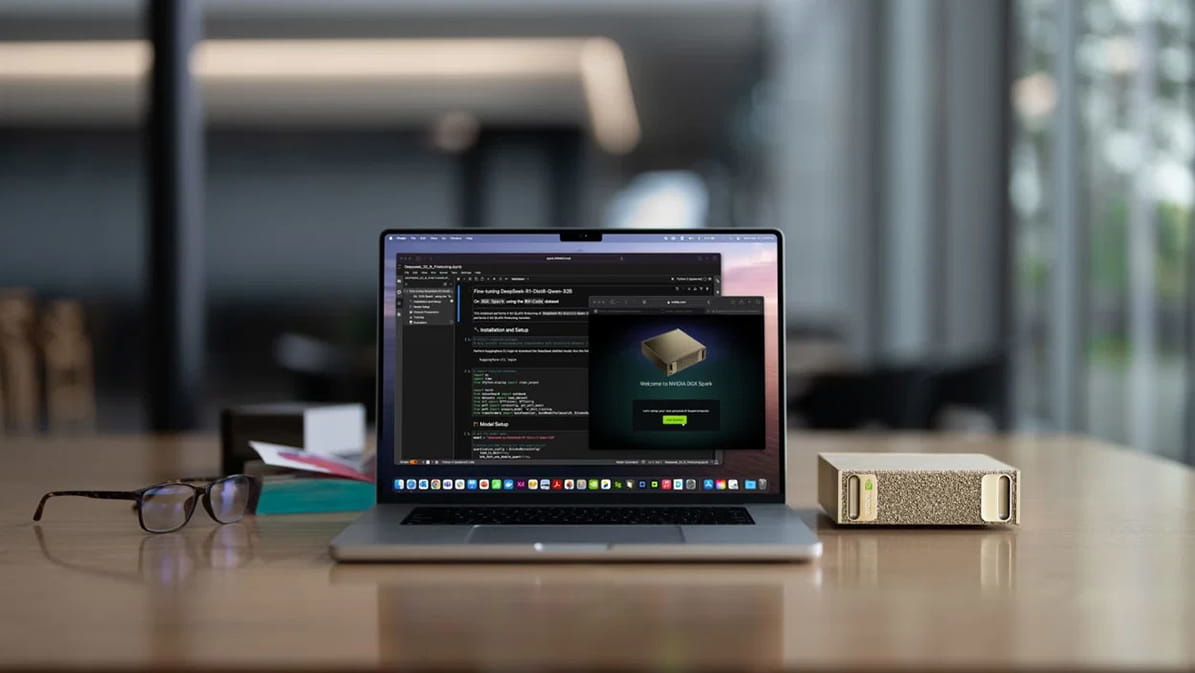
The concrete form of such integration can be seen in compact systems with NVIDIA GB10 Grace Blackwell. The NVIDIA DGX Spark 4TB, the previously mentioned Dell Pro Max with GB10 FCM1253, or the ASUS Ascent GX10 combine this platform with a ready-to-use software environment for development and local AI work. For the DGX Spark platform itself, NVIDIA specifies 128GB of unified memory, performance up to 1 PFLOP at FP4, and support for models up to 200 billion parameters.
The significance of these parameters only becomes clear in specific deployments, as the same platform can serve differently during development than during regular local inference. The way it is used will then decide whether the build remains a pilot environment or also takes over part of the team's long-term workload.
i
What should be traceable for a pre-tested platform
Before purchasing, the exact hardware configuration, supported operating system, and versions of key software layers should be known. Performance results require similar context: without information on the model used, precision, and the nature of the load, they are difficult to translate into capacity planning.
A compact AI station can handle both development and regular local work
When a company needs its own environment for development and regular local inference, GB10-class systems can cover several phases of a project on a single device. The team can use them to verify open-source models, prototype with internal data, and later run stable workloads that they no longer want to send to an external service every time.
A platform of this class is aimed mainly at scenarios that do not fit comfortably on a standard workstation due to the memory requirements of larger models. However, the declared 200 billion parameters represent an approximate limit, as actual requirements change depending on quantisation, context length, and how the application handles inference.
The higher class comes with larger models and more demanding operations
As models and context lengths grow, or as a project moves towards more demanding fine-tuning, the role of the entire build changes along with the performance requirements. From a personal or team device, it gradually becomes a shared computing node that must fit into the company's wider operations. Network connectivity and the method of allocating available resources among multiple users then gain greater importance.
Systems with NVIDIA GB300 Grace Blackwell Ultra, such as the GIGABYTE W775 or the ASUS ExpertCenter Pro ET900N G3, fall into this performance category. The DGX Station platform with GB300 offers up to 748GB of coherent memory and performance up to 20 PFLOPS FP4, with NVIDIA linking it to work with models up to one trillion parameters.
Deciding between individual classes should therefore be based on actual usage and expected growth. A smaller team might utilise a compact platform better than a more expensive system with a large surplus of headroom. If a pilot is already hitting memory limits or the project has a clear expansion plan, the necessary headroom should be part of the design from the start.
Table 3: Comparison of main AI infrastructure classes
| Build Class | Memory Class | AI Performance | Approximate Model Size | Typical Use |
|---|---|---|---|---|
| GB10 / DGX Spark class | 128GB unified memory | Up to 1 PFLOP FP4 | Up to 200bn parameters | Local development, inference, agents, pilots, and smaller team scenarios |
| GB300 / DGX Station class | 748GB coherent memory | Up to 20 PFLOPS FP4 | Up to 1 trillion parameters | Larger models, more demanding inference, fine-tuning, and shared performance |
| Classic workstation with RTX GPU | Depending on specific configuration | Depending on GPU used | Depending on VRAM, quantisation, and workload | Professional applications combined with local AI |
| Server infrastructure | Depending on design | Depending on number and type of accelerators | Depending on solution architecture | Production services for multiple teams and higher availability requirements |
Data on maximum model size represents an approximate limit of the given platform. Real-world deployment is affected by model precision, quantisation, context length, concurrency, and the nature of the workload.

RAG shows why the entire workload needs to be validated
Why a model benchmark alone is often insufficient is well illustrated by a company assistant working over internal documents. RAG, or retrieval-augmented generation, first searches for relevant information in company sources before generating a response, and only then passes it to the model. The performance of the resulting service thus depends on the entire data path.
A single user query can go through conversion into an embedding and retrieval of suitable passages in a database, followed by their ranking by relevance and assembly of the context for the model. At the same time, permissions determining what documents a specific user is allowed to access enter the equation. With long documents, pressure on memory also increases, and the path to the final answer becomes longer.
Validation for such a scenario therefore needs to work with inputs similar to those expected after deployment. If the production service handles long documents and multiple users simultaneously, a benchmark with a short prompt will show only a small part of the system's actual behaviour.
!
If the production service handles long documents and multiple users simultaneously, a benchmark with a short prompt will show only a small part of the system's actual behaviour.
Measured performance requires defined conditions
When comparing benchmarks, it is also necessary to know under what conditions the measured figure was obtained. Speed in tokens per second varies according to the model used and the precision of the calculation. With a longer input or higher concurrency, the build's behaviour will shift again, so two correct measurements can yield different results and yet not contradict each other.
Furthermore, for an interactive service, it is not enough to monitor only the generation speed after the response starts. For users, TTFT (time to first token) is also critical, as a long wait for the reaction to begin slows down daily work. P95 and p99 latencies, on the other hand, reveal the slower portion of requests, which a standard average can easily hide and which often manifests during peak times.
Table 4: Metrics for assessing AI service performance
| Metric | What it shows | How to read it in practice |
|---|---|---|
| TTFT | Time to the first visible part of the response | Affects the perceived responsiveness of the service |
| Tokens/s | Output generation speed | Helps assess user comfort and capacity |
| P95/p99 latency | Response time of the slower portion of requests | Reveals peak behaviour better than an average |
| Memory usage | Headroom for the model, context, and other requests | Often shows the practical limit of the build |
| Context length | Volume of information held during the response | Affects both memory and speed |
| Concurrency | Number of parallel requests handled | Determines usability in team operations |
Only combining these metrics with planned operations shows whether the measured performance has real value for the company. Technical results thus naturally turn into practical questions that should be resolved before choosing a specific configuration.

What should be clarified before choosing a validated AI configuration?
Before making a choice, it is advisable to know the main workload the build is to handle, the model or model size class under consideration, the typical length of inputs and responses, the number of requests at peak times, an acceptable response time for users, the sensitivity of data entering prompts and logs, responsibility for updates and monitoring, and the expected growth in usage over the next 12 to 24 months.
Why can the same type of GPU deliver different performance in practice?
A language model needs space in memory for its weights, and during inference, additional demands arise from context or handling simultaneous requests. Software can change the result just as significantly – a different version of a driver or inference engine can affect both speed and stability, and further differences arise depending on the chosen quantisation or the way the cache is handled.
What is TTFT and why does it matter?
TTFT is the time to first token – the first visible part of the response. It is critical for users because a long wait for the reaction to begin slows down daily work. For an interactive service, it is therefore not enough to monitor only the generation speed after the response starts.
Why is it not enough to validate just the model, but the entire workload?
A company assistant working over internal documents using RAG goes through the entire data path before responding – conversion to embedding, retrieving passages, ranking them, and assembling the context for the model. The performance of the resulting service thus depends on the entire chain, not just the speed of the model itself.
When is a compact GB10-class AI station suitable and when is a higher class needed?
GB10-class systems cover local development, inference, agents, and pilots for smaller teams. As models and context lengths grow, or as a project moves towards more demanding fine-tuning and shared operations for multiple users, a higher class comes into play, such as systems with GB300 Grace Blackwell Ultra.
Where a pre-tested build saves time and reduces risk
The greatest benefit of a pre-tested configuration is realised when a company can already describe its task fairly accurately. Knowing the planned model and data type allows for measuring performance that actually matters for the project, while also better estimating the necessary headroom for growth.
In the early stages of a project, it can be advantageous to run the first experiments in the cloud, where models and available capacity can be easily changed. Repeated workloads will then provide the basis for considering on-premises infrastructure. Once the team knows the real operational peaks and approximate volume of work, the choice of a pre-tested platform is based on more concrete data.
For projects involving sensitive information, the question of control over the flow of documents, prompts, and operational logs is added to performance. Validating the build itself does not solve security, as that still depends on the application design and the company's access rules. However, a predictable hardware and software environment gives the team a more stable foundation on which to build these measures.
i
Where the most work is saved
The greatest savings usually occur before production deployment. A known and supported combination of hardware and software environment allows the team to start measuring the actual solution in company operations sooner. Time can thus be spent on document quality, typical queries, user behaviour, and security rules instead of troubleshooting basic compatibility issues.
Before ordering an AI build, it is necessary to know the specific workload, the scope of verification, and the conditions under which the stated performance results were achieved. Their combination will show whether the documentation provides a usable basis for the planned service or leaves fundamental questions to be answered by your own testing after purchase. Well-documented validation primarily saves the time of the technical team, who can focus on measurement, integration, and the behaviour of the solution in the corporate environment sooner after delivery. If the description of the test, supported stack, and performance conditions is missing, technical questions are merely postponed until after the order is placed, where resolving them is usually slower and more expensive.

Peter Vnuk
A technológia egyszerre munka és szórakozás számomra - leginkább az okostelefonok, laptopok, audio, mesterséges intelligencia és minden más hi-tech dolog érdekel. Szeretem áttekinteni a híreket, követni a futurisztikus trendeket és megjósolni a technológia következő fejleményeit. Lenyűgöznek a sci-fik és a jövő világáról szóló víziók, amelyek gyakran valódi technológiai fejlesztéseket inspirálnak. Szakmailag is foglalkozom videojátékokkal és a játékiparral. Amikor nem dolgozom, szeretek kikapcsolódni egy jó játékkal, egy jó sörrel, vagy tech-mémek készítésével a Facebookon.