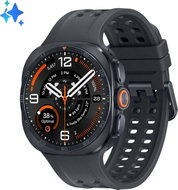
I'll start with the data transfer, which basically doesn't work. You can't go a step back in the process, and your old watch is disconnected from Bluetooth the moment you connect the new one. Overall, it's a very poorly executed feature. In the end, I had to set up the watch as a new device from scratch. Without asking, the setup guide tried to automatically transfer the eSIM from my phone; luckily my network operator blocked it. The design and controls of the watch are exactly the same as the previous two Ultra models. So don't expect any changes. You'll only notice the absolutely minimal difference in thickness if you have both watches on your wrist next to each other. Similarly, the minimal increase in display size isn't really noticeable. What is a bit more noticeable is the display brightness; its readability in direct sunlight is excellent. Both compared to the previous model and compared to all other manufacturers.
The second thing that caught my eye is the strap. It's more delicate, more flexible, feels much more comfortable to wear, and my wrist sweats less under it. It's just a bit harder for me to fasten, but that's probably just a matter of getting used to it.
The straps are still compatible between all three versions: the Samsung Galaxy Watch Ultra1, 2025 and Ultra 2. My measurements show the new watch charges at 5.2W, while the previous Galaxy Watch Ultra shows 3.5W. So the charging itself has indeed been sped up. But, thanks to the larger battery capacity, it takes basically the same amount of time as the original watch. This is a problem, especially for those who want to wear it for 24/7 health monitoring. For me, the best option is to wear this watch during the day and for sports, and the Samsung Ring overnight (if it were available, which it currently isn't). The Samsung GW Ultra 1 also charges on the new charger and vice versa, the new one charges on the old charger, just more slowly. Back to the battery, with very active use, including regular sports, it now works out to charging every other day instead of every day. The hardware, including the chip, is harder to evaluate. The system is smooth and responds very quickly when it's new. We'll see, of course, as time goes on and it gets bloated. Unfortunately, the storage capacity hasn't gone anywhere; it's still 64GB, and you can only use LTE and Spotify for shorter exercise sessions. Because if you combine it with running, GPS, LTE, and music playback, the battery percentage plummets very quickly. The software features seem to be the weakest point for me so far. Yes, you can of course install third-party apps, but then you fall out of the ecosystem, which is exactly what you don't want. If you want to use a Samsung ring/watch/phone, you want the required functionality to be in the Health app or its connected apps. And this is where I see the least progress. From my running perspective, for example, I absolutely don't understand why the watch doesn't have features that are completely standard today. The coach is basically not customisable to function like any chatbot where you enter your inputs and it generates your workouts. Here, it has more than half of all your data available, but the selection options are almost zero. When I want to run a race, I have no option at all to preset and monitor my pace on the road, upload a GPX file, nothing. I can only have it tell me about 10 different pieces of information, either by kilometre or by minute. Yet for trail running, there's at least something (and for cycling/hiking too). But the reality of even the 'trail' running is again rather disappointing. The idea that I could, for example, upload it to OneDrive and then select it directly in the app is out of the question. Okay, even with a more complicated procedure, I managed to generate a GPX in mapy.cz, upload it to the phone's storage via OneDrive, and then import it. The first disappointment was the map; it loads some grey map in the background on which you can see basically nothing. No streets, no terrain markers, no labels, nothing. The map can't be zoomed in or out; after a few minutes, I managed to pan it without switching to another running screen. So it's completely uncontrollable while running. It offers basically no quick orientation in the terrain, whether I'm in the city or outside it, so it loses its purpose. Only the audio navigation works. I compared the heart rate measurement with a chest strap; in Z1-Z4 the deviation was +-1bpm, which I consider an excellent result in terms of accuracy. What's worse is that you still can't connect a chest strap to the watch. Yet today's modern chest straps provide lots of data that needs to be collected directly from the torso for advanced sports metrics. Blood pressure again doesn't work without initial calibration. According to the documentation, however, the biggest flaw of the watch remains: this calibration is required every 28 days. This is the price for it meeting the standards of a medical device ☹ And it is also one of the most annoying things for the user. For example, you go on holiday somewhere, the next day your watch beeps that your calibration has expired, and you're out of luck for the rest of your holiday. Overall summary
It's a perfect watch from a hardware perspective. It has a fairly well-tuned system for work-office use and communication. It has above-average software for life functions and health. And it has a very neglected software component for athletes, especially in this price category. So it's still a big compromise for athletes whether to stay in the Samsung ecosystem, which in this area is still far from matching the competition.