


FIFINE T683
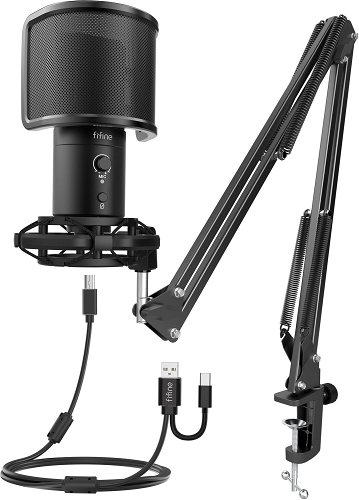

FIFINE T683

The FIFINE T683 desk condenser microphone with an adjustable arm is ideal for you if you want to record high-quality podcasts or accompany your gaming with clear and loud commentary. Its key benefits include wide compatibility, a highly adjustable stand, an instant mute button, and the option to use a modern USB-C connector. However, thanks to the included cable, the FIFINE T683 microphone can also be connected to a device with a USB-A port.

Desk
Microphone type
Condenser
Microphone principle
Directional (Cardioid)
Directional characteristics
50–17,000Hz
Frequency range
Key Features of the FIFINE T683 Microphone
- The microphone can be used for podcasts or interviews
- The practical, up to 76cm long arm allows for perfect adjustment
- Connect it using the detachable 2.5-metre-long USB-A and USB-C cable
- The U-shaped pop filter effectively reduces unpleasant noise
- Easy connection thanks to the Plug & Play function
- The cardioid directional characteristic suppresses sound reception from the rear of the microphone

Suitable for Studio Use, Streaming, and Podcasts

You'll Find Many Accessories Included with the FIFINE T683 Microphone
When using the FIFINE T683 microphone, you need a whole range of accessories. The package includes a practical adjustable arm with a length of up to 76cm, which allows you to set the microphone in the ideal position. Thanks to the desk edge clamp and quality construction, no harmful interference is transmitted to the FIFINE T683 microphone. Also included is a U-shaped pop filter, which effectively reduces unpleasant noise. And if you have ambitions to use the microphone on the go, you will appreciate the 3/8" to 5/8" tripod adapter.
Controls are located directly on the body of the FIFINE T683 microphone
You will certainly appreciate that when designing the FIFINE T683 microphone, the manufacturer listened to users' requests and fitted its body with several controls. You get a quick mute button, a 3.5mm jack for real-time monitoring, an active microphone LED indicator, and a convenient volume dial. The FIFINE T683 microphone works on the Plug & Play principle, so you just need to plug it in and start using it immediately.
Technical Specifications
- Sensitivity: -43dB
- Number of channels: 1
- Transmission Technology: Digital
- Weight: 1,500g
- Cable length: 2.5m
- Receiver connectors: USB-C
- Compatibility: Windows, macOS
Package Contents
- Microphone
- USB cable
- Arm
- Adapter
- U-shaped pop filter
- Desk mount
- Microphone holder
 Microphone Principle
A dynamic microphone is suitable for open performances, live broadcasts, music production, etc. It uses a magnet and a moving coil to capture sound.
A condenser microphone is mainly used for studio purposes. It has higher sensitivity and lower noise. It needs to be powered separately.
 Frequency Range
The frequency range indicates the range of frequency values that the microphone records. The wider the range, the more sounds it can capture.
Low frequencies (e.g., 20–200Hz): Bass, the deepest tones of instruments (double bass, kick drum) and male voices.
Mid-range frequencies (e.g., 200–3,000Hz): The body of instruments, the foundation of the voice where the ear is most sensitive, important for speech clarity.
High frequencies (e.g., 3,000–14,000Hz): Treble, details, sibilance, and the "sparkle" of the sound.
Air band (above 14,000Hz): Adds a sense of expensive, super high-quality sound and space to recordings.
 Sensitivity
Microphone sensitivity is the ratio of output voltage to acoustic pressure. It expresses how loud a signal the microphone produces at a given acoustic pressure; higher sensitivity means a stronger voltage and is suitable for quiet studios, while lower sensitivity is better for noisy environments as it doesn't unnecessarily amplify ambient noise.
Specifications
Connection
Microphone characteristics
Features
Weight
Specifications can be changed without notice. Images are for illustrative purposes only.